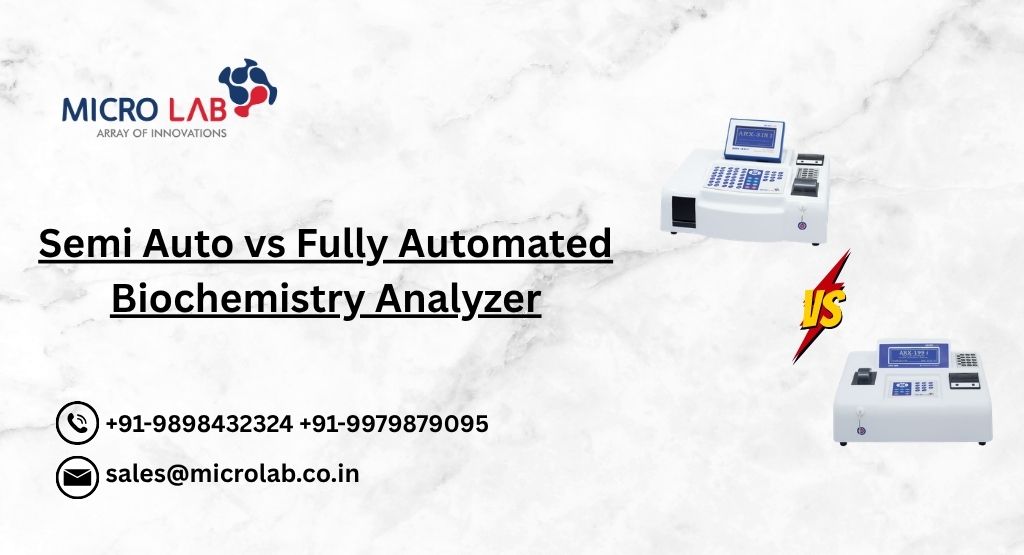
Modern laboratories require speed, precision, and workflow efficiency to deliver accurate diagnostic results. Choosing the right biochemistry analyzer plays a critical role in improving laboratory ivity and maintaining testing accuracy.
Many diagnostic centers, hospitals, and pathology labs often face one important question — should they invest in a semi auto biochemistry analyzer or a fully automated biochemistry analyzer?
The right choice depends on testing volume, operational needs, budget, and future laboratory expansion. In this guide, Micro Lab Instruments explains the key differences, benefits, applications, and buyer considerations to help laboratories make the right investment decision.
What Is a Biochemistry Analyzer?
A biochemistry analyzer is a laboratory diagnostic device used to analyze biological samples such as blood, plasma, serum, and urine. These systems help healthcare professionals perform tests related to glucose, cholesterol, liver function, kidney function, enzymes, proteins, and metabolic disorders.
Modern biochemistry machines improve testing speed, reduce manual errors, and support accurate clinical diagnosis.
Why Are Biochemistry Analyzers Important in Modern Laboratories?
A biochemistry analyzer helps laboratories achieve faster reporting, improved workflow management, and reliable test accuracy. Automated systems also reduce technician workload and improve operational efficiency.
Key Benefits of Using a Biochemistry Analyzer
- Faster sample processing
- Improved testing accuracy
- Reduced manual intervention
- Better workflow efficiency
- High-volume testing capability
- Consistent diagnostic performance
- Reliable laboratory operations
For diagnostic labs in Ahmedabad and across India, automation has become essential for handling increasing patient loads efficiently.
Semi Auto vs Fully Automated Biochemistry Analyzer
Understanding the difference between a semi auto biochemistry analyzer and a fully automated biochemistry analyzer is important before making a purchasing decision.
Both systems are designed for clinical chemistry testing, but they differ in automation level, speed, throughput capacity, and operational efficiency.
What Is a Semi Auto Biochemistry Analyzer?
A semi auto biochemistry analyzer requires partial manual handling during the testing process. The operator manually prepares samples and reagents before analysis.
These systems are commonly used in:
- Small pathology laboratories
- Clinics and diagnostic centers
- Educational institutions
- Rural healthcare facilities
Advantages of Semi Auto Biochemistry Analyzer
- Lower initial investment
- Easy to operate
- Compact design
- Affordable maintenance
- Suitable for low to medium testing volume
What Is a Fully Automated Biochemistry Analyzer?
A fully automated biochemistry analyzer performs the entire testing process automatically, including sample loading, reagent mixing, analysis, and report generation.
These systems are ideal for:
- High-volume diagnostic laboratories
- Multi-specialty hospitals
- Advanced pathology labs
- Research and healthcare institutions
Advantages of Fully Automated Biochemistry Analyzer
- High-speed testing
- Minimal manual intervention
- Improved reporting accuracy
- Better workflow automation
- Large sample processing capacity
What Factors Should Buyers Consider Before Purchasing?
Before investing in a biochemistry analyzer, laboratories should evaluate operational efficiency, workflow needs, and long-term scalability.
1. Testing Volume: High testing volumes generally require a fully automated biochemistry analyzer for faster processing and improved efficiency.
2. Accuracy Requirements: Advanced diagnostic centers often prefer automatic biochemical analyzers for better consistency and precision.
3. Service and Technical Support: Reliable after-sales service is critical for uninterrupted laboratory operations.
4. Software Integration: Modern systems offer LIS connectivity, automated reporting, and quality control features.
5. Future Expansion: Selecting scalable equipment helps laboratories manage future growth efficiently.
Understanding Biochemistry Analyzer Price in India
The biochemistry analyzer price depends on several factors, including automation level, throughput capacity, technology, software features, and service support.
Factors Affecting Biochemistry Analyzer Price
- Automation technology
- Testing speed
- Number of parameters
- Software integration
- Brand reputation
- Warranty and support services
While semi auto biochemistry analyzers are budget-friendly, fully automated biochemistry analyzers offer better long-term ivity and operational efficiency.
Applications of Biochemistry Analyzers
A biochemistry analyzer is widely used in healthcare and research sectors for clinical diagnostics and laboratory testing.
Common Applications
- Clinical pathology laboratories
- Hospital diagnostic centers
- Preventive healthcare testing
- Research institutions
- Veterinary diagnostics
- Healthcare diagnostic systems
These systems support testing related to diabetes, kidney disorders, liver diseases, cholesterol monitoring, and metabolic conditions.
Why Laboratories Choose Micro Lab Instruments
Micro Lab Instruments is a trusted provider of laboratory diagnostic equipment in Ahmedabad and across India.
What Makes Micro Lab Instruments Different?
- Quality-tested laboratory systems
- Reliable after-sales support
- Industry expertise
- Competitive pricing
- Customized laboratory solutions
- Trusted technical assistance
Whether you need a semi auto biochemistry analyzer or a fully automated biochemistry analyzer, choosing the right supplier is equally important as choosing the right equipment.
Conclusion
Choosing between a semi auto biochemistry analyzer and a fully automated biochemistry analyzer depends on your laboratory’s testing volume, workflow requirements, and budget.
A semi auto biochemistry analyzer is suitable for smaller laboratories looking for affordable and reliable testing solutions. In contrast, a fully automated biochemistry analyzer is ideal for high-volume laboratories that require speed, precision, and workflow automation.
Investing in the right biochemistry analyzer improves laboratory efficiency, reporting accuracy, and long-term operational performance. With expert guidance from Micro Lab Instruments, laboratories can confidently choose the right diagnostic solution for their needs.
Looking for the best biochemistry analyzer for your laboratory?
Micro Lab Instruments offers reliable semi auto biochemistry analyzers, fully automated biochemistry analyzers, and advanced laboratory diagnostic equipment designed for modern healthcare facilities across Ahmedabad and India.
Contact us today, request a quote, or get expert guidance for selecting the right diagnostic solution for your laboratory.
Read More: Fully Automated Biochemistry Analyzers: Revolutionizing Diagnostic, How to Choose the Right Basket Strainer for Industrial Pipelines