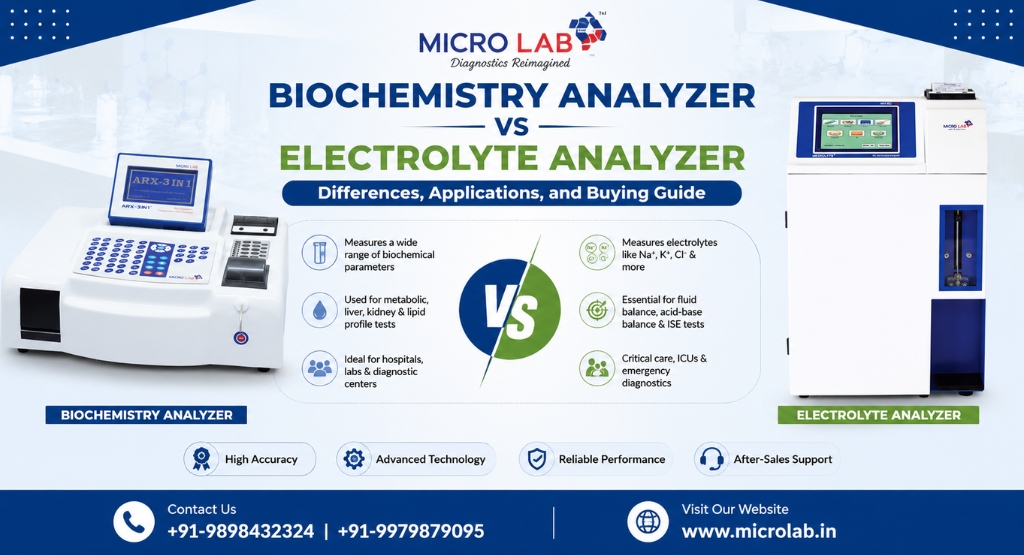
Selecting the right diagnostic laboratory equipment is essential for ensuring accurate test results, efficient workflows, and reliable patient care. Among the most commonly used instruments in modern laboratories are the Biochemistry Analyzer and Electrolyte Analyzer. While both systems play critical roles in clinical diagnostics, they serve different testing purposes and provide distinct analytical capabilities.
Many laboratory owners, hospital administrators, procurement teams, and diagnostic center operators often compare these instruments when planning laboratory investments or upgrading existing facilities. Understanding the differences between a Biochemistry Analyzer and an Electrolyte Analyzer helps buyers make informed purchasing decisions based on testing volume, clinical requirements, budget, and operational goals.
As a trusted manufacturer and supplier of diagnostic laboratory equipment, Micro Lab Instruments provides advanced laboratory solutions designed to improve accuracy, efficiency, and reliability across healthcare facilities.
What is a Biochemistry Analyzer?
A Biochemistry Analyzer is a laboratory instrument used to measure chemical components in biological samples such as blood, serum, plasma, and urine. It performs a wide range of biochemical tests that assist healthcare professionals in diagnosing, monitoring, and managing various diseases.
A Biochemistry Analyzer is a clinical chemistry analyzer that automates the testing of blood and body fluid samples to evaluate organ function, metabolic disorders, diabetes, lipid profiles, liver health, kidney function, and other biochemical parameters.
Common Tests Performed by a Biochemistry Analyzer
- Liver Function Tests (LFT)
- Kidney Function Tests (KFT)
- Blood Glucose Testing
- Lipid Profile Analysis
- Cholesterol Testing
- Uric Acid Testing
- Protein Analysis
- Enzyme Assays
- Cardiac Marker Testing
- Metabolic Profile Testing
What is an Electrolyte Analyzer?
An Electrolyte Analyzer is a specialized diagnostic instrument designed to measure electrolyte concentrations in biological fluids.
An Electrolyte Analyzer measures essential electrolytes such as sodium, potassium, chloride, calcium, and lithium in blood, serum, plasma, or urine samples using ion-selective electrode (ISE) technology.
Common Electrolytes Measured
- Sodium (Na+)
- Potassium (K+)
- Chloride (Cl−)
- Calcium (Ca++)
- Lithium (Li+)
Electrolyte analyzers are commonly used in emergency departments, ICUs, nephrology units, critical care settings, and routine diagnostic laboratories.
Biochemistry Analyzer vs Electrolyte Analyzer: Key Differences
| Feature | Biochemistry Analyzer | Electrolyte Analyzer |
|---|---|---|
| Primary Function | Chemical and metabolic testing | Electrolyte measurement |
| Parameters Tested | Multiple biochemical markers | Sodium, potassium, chloride, calcium, lithium |
| Technology | Photometric, colorimetric, turbidimetric methods | Ion Selective Electrode (ISE) technology |
| Test Menu | Broad and versatile | Specialized and focused |
| Clinical Applications | General diagnostics and disease monitoring | Fluid and electrolyte balance assessment |
| Throughput | Medium to high volume testing | Fast and rapid electrolyte testing |
| Sample Types | Serum, plasma, urine, whole blood | Whole blood, serum, plasma, urine |
| Laboratory Usage | Clinical chemistry laboratories | Emergency and critical care laboratories |
How Does a Biochemistry Analyzer Work?
A Clinical Chemistry Analyzer performs automated biochemical testing through sophisticated optical and chemical reaction systems.
Working Process
- Sample loading
- Reagent dispensing
- Chemical reaction initiation
- Optical measurement
- Data processing
- Result generation
How Does an Electrolyte Analyzer Work?
Electrolyte analyzers typically use Ion Selective Electrode (ISE) technology.
Working Process
- Sample aspiration
- Contact with ion-selective electrodes
- Electrical potential measurement
- Concentration calculation
- Report generation
Applications of Biochemistry Analyzers
Hospitals and Multispecialty Healthcare Facilities: Biochemistry analyzers support routine health screenings and disease diagnosis.
Diagnostic Laboratories: They help process large testing volumes efficiently while maintaining result consistency.
Research Laboratories: Researchers use these analyzers for biochemical investigations and clinical studies.
Preventive Healthcare Programs: Health checkup packages rely heavily on biochemistry testing to assess patient wellness.
Applications of Electrolyte Analyzers
Intensive Care Units (ICU): Rapid electrolyte assessment is critical for critically ill patients.
Emergency Departments: Immediate electrolyte testing supports urgent treatment decisions.
Dialysis Centers: Electrolyte monitoring is essential for patients undergoing kidney dialysis.
Cardiology Departments: Abnormal electrolyte levels can significantly impact cardiac function and patient outcomes.
Benefits of Using a Biochemistry Analyzer
Comprehensive Test Menu: A single analyzer can perform numerous diagnostic tests.
Increased Laboratory Productivity: Automation reduces manual intervention and improves workflow efficiency.
High Accuracy and Consistency: Advanced technologies minimize testing errors.
Cost Efficiency: Automated systems reduce labor costs and reagent wastage.
Faster Turnaround Time: Rapid reporting enhances patient care and laboratory efficiency.
Benefits of Using an Electrolyte Analyzer
Rapid Testing: Results are available within minutes or even seconds.
Critical Care Support: Essential for emergency and ICU patient management.
High Precision: ISE technology provides highly accurate electrolyte measurements.
Compact Design: Many electrolyte analyzers require minimal laboratory space.
Low Sample Volume Requirement: Useful for pediatric and critical-care applications.
Which Analyzer Should You Choose?
Choose a Biochemistry Analyzer If:
- You require a broad range of diagnostic tests.
- Your laboratory handles routine chemistry testing.
- You need high-volume clinical chemistry analysis.
- You want comprehensive disease screening capabilities.
Choose an Electrolyte Analyzer If:
- You focus on electrolyte testing.
- You operate emergency or critical care services.
- Rapid electrolyte assessment is essential.
- You require dedicated electrolyte analysis.
Best Practice
Many hospitals and diagnostic laboratories utilize both systems together to provide complete diagnostic coverage.
Factors Affecting the Price of Biochemistry and Electrolyte Analyzers
Several factors influence equipment pricing:
Biochemistry Analyzer Pricing Factors
- Fully automatic or semi-automatic operation
- Test throughput capacity
- Number of parameters supported
- Automation level
- Software capabilities
- Reagent compatibility
- Brand reputation
Electrolyte Analyzer Pricing Factors
- Number of electrolyte parameters
- Testing speed
- Electrode technology
- Calibration system
- Maintenance requirements
- Connectivity features
How to Choose the Right Manufacturer or Supplier
Product Quality: Look for reliable and proven diagnostic laboratory equipment.
Technical Support: Ensure availability of installation, training, and troubleshooting assistance.
After-Sales Service: Reliable maintenance support minimizes downtime.
Spare Parts Availability: Quick access to consumables and replacement components is essential.
Industry Experience: An experienced manufacturer often provides better application knowledge and technical guidance.
Regulatory Compliance: Verify applicable quality standards and certifications.
OEM and Customization Options
Many healthcare organizations require customized laboratory solutions.
A reliable manufacturer should be able to provide:
- OEM branding
- Customized configurations
- Software integration support
- Laboratory workflow optimization
- Application-specific solutions
Micro Lab Instruments supports healthcare institutions with tailored laboratory equipment solutions designed to meet diverse diagnostic requirements.
Why Laboratories Trust Micro Lab Instruments
As a trusted manufacturer, supplier, exporter, and diagnostic laboratory equipment solution provider, Micro Lab Instruments delivers advanced analytical systems designed for modern healthcare environments.
Key strengths include:
- Extensive industry experience
- Reliable quality
- Advanced technology solutions
- Comprehensive technical support
- Competitive pricing
- Timely delivery
- Customer-focused approach
- Strong after-sales service network
These capabilities help laboratories improve efficiency, accuracy, and long-term operational performance.
Conclusion
Understanding the differences between a Biochemistry Analyzer and an Electrolyte Analyzer is essential for selecting the right diagnostic solution. While a Biochemistry Analyzer provides comprehensive clinical chemistry testing across multiple parameters, an Electrolyte Analyzer specializes in rapid and accurate electrolyte measurement for critical diagnostic applications.
For hospitals, diagnostic laboratories, research centers, and healthcare facilities, the ideal choice depends on testing requirements, patient volume, laboratory workflow, and budget considerations. In many cases, integrating both systems delivers the most comprehensive diagnostic capability.
By partnering with an experienced manufacturer and supplier like Micro Lab Instruments, healthcare organizations can access reliable diagnostic laboratory equipment backed by expert support, quality assurance, and long-term service commitment.
Looking for a reliable Biochemistry Analyzer, Electrolyte Analyzer, or complete Diagnostic Laboratory Equipment solution? Contact Micro Lab Instruments today to discuss your laboratory requirements, request a customized quotation, and receive expert guidance for selecting the right diagnostic solution for your healthcare facility.
Read More: Top Biochemistry Analyzer Manufacturer in India, The Best Biochemistry Analyzer for Diagnostic Laboratories in 2026